© Beth Rasala, UCSD
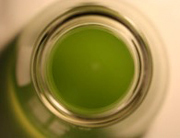
フラスコの中のコナミドリムシ
癌などの治療に使われるヒトのタンパク質は,培養した細菌や哺乳類の細胞で作られるが,生産コストが高く,治療費が高額になる。そこで,生物学の実験で使われてきたコナミドリムシという藻を使って生産を試みたところ,肺気腫に使われるVEGF,免疫細胞を活性化するHMGB1などのタンパク質を非常に低コストで生産できる可能性が明らかになった。コナミドリムシはバイオ燃料に利用する研究が進んでおり,これに伴う費用削減も考慮すると,将来,治療用ヒトタンパク質の最も安価な生産に寄与すると予想される。(吉田素子)
Pharmaceutical companies(1) could substantially(2) reduce the expense of costly(3) treatments for cancer(4) and other diseases produced from mammalian(5) or bacterial(6) cells(7) by growing these human therapeutic proteins(8) in algae(9) -- rapidly growing aquatic plant(10) cells that have recently gained attention(11) for their ability to produce biofuels(12).
That’s the conclusion of a study, published online(13) this week in Plant Biotechnology(14) Journal, which sought to(15) determine whether seven diverse(16) human therapeutic proteins could be produced in Chlamydomonas reinhardtii(17), a green alga(18) used widely in biology(19) laboratories(20) as a genetic(21) model organism(22), much like the fruit fly(23) Drosophila(24) and the bacterium(25) E. coli(26).
“What surprised us was that of the seven genes(27) chosen, four expressed(28) proteins at levels sufficient for commercial production(29),” said Stephen Mayfield, a professor of biology at the University of California, San Diego who headed the study, which involved scientists at The Scripps Research Institute, San Diego biofuel company Sapphire Energy and ProtElix, a protein engineering(30) company in Hayward, CA.
The scientists reported in their paper that all of the algal-produced(31) proteins in their study showed biological(32) activity(33) comparable to(34) the same proteins produced by traditional commercial techniques(35). And because algae cells can be grown cheaply(36) and quickly, doubling in number(37) every 12 hours, they noted that algae could be superior to(38) current biological systems for the production of many human therapeutic proteins.
“Currently(39), human therapeutic proteins are primarily(40) produced from either bacteria(41) or mammalian cell culture(42),” they said. “Complex mammalian proteins and monoclonal antibodies(43) are primarily produced by the culture of transgeneic(44) mammalian cells, while simpler proteins are generally produced by E. coli.”
(1) 製薬会社 (2) 大幅に (3) 高価な (4) 癌 (5) 哺乳類の (6) 細菌の (7) 細胞
(8) 治療用タンパク質 (9) 藻類 (10) 水生植物 (11) 注目を集めた (12) バイオ燃料
(13) オンラインで発表された (14) 植物バイオテクノロジー(Plant Biotechnology Journalは雑誌名)
(15) ~しようとした (16) 様々な (17) コナミドリムシ(学名) (18) 緑藻 (19) 生物学の
(20) 研究室 (21) 遺伝学的 (22) モデル生物 (23) ショウジョウバエ (24) ショウジョウバエ(学名)
(25) 細菌 (26) 大腸菌(学名の略) (27) 遺伝子 (28) 発現した (29) 商業生産
(30) タンパク質工学 (31) 藻類で生産された (32) 生物学的 (33) 活性 (34) ~に匹敵する
(35) 商業用技術 (36) 安価に (37) 数が倍になる (38) ~よりも優れている (39) 現在 (40) 主として
(41) 細菌(複数形) (42) 細胞培養 (43) モノクローナル抗体 (44) トランスジェニック