(C) Newcastle University
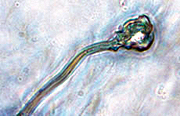
体外で作られた精子
英国の研究班が,人間の胚性幹細胞から精子を作り出すことに成功した。胚性幹細胞は,受精卵が細胞分裂してできた胚から作られる幹細胞で,様々な種類の細胞に成長できる。研究班は,性染色体の組み合わせがXY(男性)の幹細胞を,ビタミンAから作り出した物質を含む環境で培養するなど,特別な技術を使って完全に成熟した精子を得た。この技術は,男性側の不妊の原因や,疾患が遺伝するしくみの解明に非常に役立つという。研究班は,作り出した精子を不妊治療の目的で直接,人工授精に使うといったことは意図していないと強調した。(吉田素子)
Human sperm(1) have been created using embryonic stem cells(2) for the first time in a scientific development which will lead researchers(3) to a better understanding of the causes of infertility(4).
Researchers led by Professor Karim Nayernia at Newcastle University and the NorthEast England Stem Cell(5) Institute (NESCI) have developed a new technique which has made the creation of human sperm possible in the laboratory(6).
The work is published today (8th July 2009) in the academic journal Stem Cells and Development.
The NorthEast England Stem Cell Institute (NESCI) is a collaboration(7) between Newcastle and Durham Universities, Newcastle NHS Foundation Trust and other partners.
Professor Nayernia says: “This is an important development as it will allow researchers to study in detail(8) how sperm forms and lead to a better understanding of infertility in men – why it happens and what is causing it. This understanding could help us develop new ways to help couples suffering infertility so they can have a child which is genetically(9) their own.”
“It will also allow scientists to study how cells(10) involved in(11) reproduction(12) are affected by toxins(13), for example, why young boys with leukaemia(14) who undergo(15) chemotherapy(16) can become infertile(17) for life(18) – and possibly lead(19) us to a solution.”
The team also believe that studying the process of forming sperm could lead to a better understanding of how genetic diseases(20) are passed on(21).
In the technique developed at Newcastle, stem cells with XY chromosomes(22) (male) were developed into germline stem cells(23) which were then prompted(24) to complete meiosis(25) - cell division(26) with halving(27) of the chromosome set(28). These were shown to produce fully mature, sperm called scientifically(29), In Vitro Derived sperm(30) (IVD sperm).
(1) 精子 (2) 胚性幹細胞 (3) 研究者 (4) 不妊(症)
(5) 幹細胞(NorthEast England Stem Cell Instituteは研究所の名称) (6) 実験室
(7) 協力によるもの (8) 詳細に (9) 遺伝的に (10) 細胞 (11) ~に関与する (12) 生殖
(13) 毒素,毒性のあるもの (14) 白血病 (15) 受ける (16) 化学療法 (17) 不妊の (18) 一生
(19) (~A to B)AをBへと導く (20) 遺伝性疾患 (21) 受け継がれる (22) XY染色体
(23) 生殖(系列)幹細胞 (24) (be ~ to B)Bするよう促される (25) 減数分裂 (26) 細胞分裂
(27) 半分にすること (28) 染色体組(セット) (29) 科学的に (30) 体外で作られた精子